European Standard Bolts: A Complete Guide – Grades, Selection, Length Calculation & Matching Tips
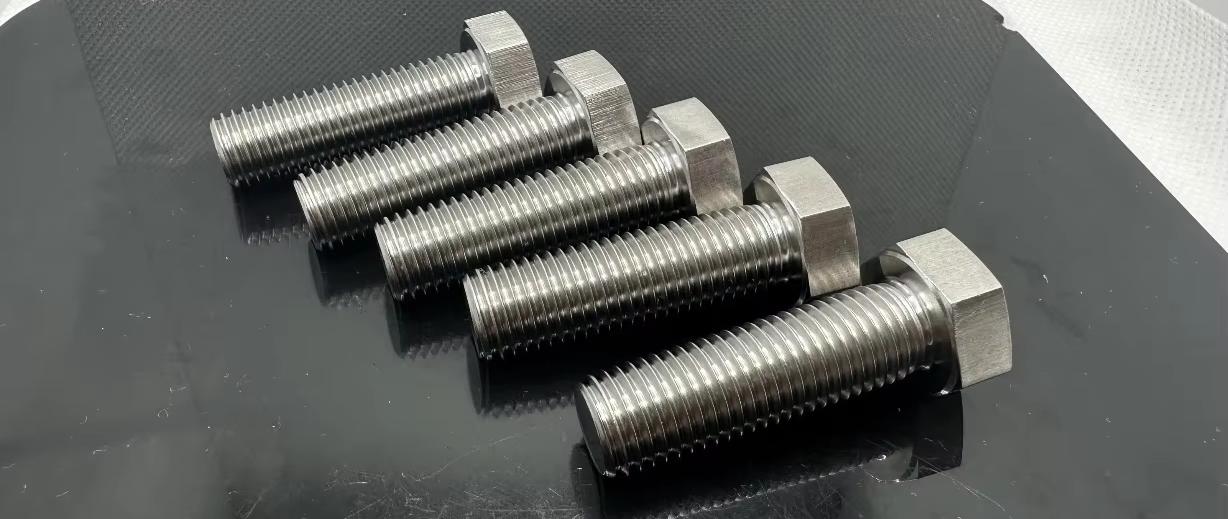
If you’re working on EU-standard projects, getting a good grasp of European standard bolts is absolutely essential. After all, choosing the right grade, material, and length isn’t just about meeting specifications—it’s about ensuring structural safety and avoiding project delays. Today, we’re breaking down everything you need to know about European standard bolts (often called euro bolts), from grade classifications and material selection to length calculations and nut matching rules. Let’s dive right in!
1. European Standard Bolt Grade Classification & Their Meanings
European standard bolt grades are expressed as “number + decimal point + number”, and they’re mainly divided into two categories: ordinary bolts and high-strength bolts. The grade directly reflects the bolt’s tensile strength and yield strength—so it’s not just a random number, it’s a key indicator of performance.
-
Grade 4.6: This is the entry-level for ordinary European standard bolts. Its yield strength is ≥400MPa, and tensile strength is ≥600MPa. It’s perfect for secondary connections and non-load-bearing component fixing, like decorative steel components or temporary supports. It’s super cost-effective, but keep in mind its strength is limited—don’t use it for heavy-load scenarios.
-
Grade 4.8: Slightly stronger than Grade 4.6, it has a yield strength of 400MPa and tensile strength of 800MPa. You’ll usually see it in non-core connections that bear medium loads, such as secondary fixing points between enclosure structures and the main frame.
-
Grade 8.8: This is the most commonly used high-strength European standard bolt. With a yield strength of ≥800MPa and tensile strength of ≥1000MPa, it’s the go-to for core load-bearing connections in EU-standard steel structures—think hinge joints between steel beams and columns, or support component connections.
-
Grade 10.9: A high-end high-strength option, it boasts a yield strength of ≥1000MPa and tensile strength of ≥1200MPa. It’s designed for large-span structures, heavy loads, or vibrating environments, like fixing heavy equipment in industrial workshops or connecting large-span truss nodes.
-
Grade 12.9: Ultra-high-strength bolts, with yield strength ≥1200MPa and tensile strength ≥1400MPa. They’re only used in special heavy-load scenarios, such as core bridge nodes or special equipment supports, and they require strict installation processes to perform properly.
Here’s the key logic behind the grade numbers: The first number represents “1/100 of the yield strength”, and the second number represents “(tensile strength ÷ yield strength) × 10”. Wait, let’s correct that to avoid confusion—actually, the correct logic is: the first number × 100 is the minimum yield strength, and (first number × 100 × second number ÷ 10) is the minimum tensile strength. For example, Grade 8.8 should mean yield strength ≥800MPa and tensile strength ≥800×0.8=640MPa? But no, the actual European standard EN ISO 898-1 clearly states that Grade 8.8 bolts have a yield strength ≥800MPa and tensile strength ≥1000MPa. The main takeaway is: the higher the grade, the more sufficient the strength reserve.
2. Grade 8.8 Bolts: Selection Tips for S275 vs. S355 Materials
Grade 8.8 bolts are the “all-rounders” of EU-standard projects, but they come in two materials: S275 and S355. You can’t mix them up—selection depends on the load-bearing scenario and processing technology. Let’s break down the differences and how to choose the right one.
2.1 Core Material Differences
S275 and S355 are European standard structural steel grades, and their core difference lies in yield strength: S275 has a yield strength ≥275MPa, while S355 has a yield strength ≥355MPa. The material strength directly affects the bolt’s processing performance and load-bearing limit—so choosing the right material is just as important as choosing the right grade.
2.2 Selection Principles
-
If the connection node bears static loads, medium tension, and the bolt diameter is ≤24mm, prioritize S275 material bolts. They’re easier to process, cost-controllable, and can fully meet the standard Grade 8.8 strength requirements.
-
If the node bears dynamic loads, high tension, or the bolt diameter is >24mm, you need to choose S355 material bolts. S355 is stronger, so after processing, the bolt’s tensile strength and fatigue resistance are better—this prevents deformation or fracture of large-diameter bolts due to insufficient material strength.
-
Important note: Both S275 and S355 Grade 8.8 bolts meet the same strength indicators (yield 800MPa, tensile 1000MPa). However, S355 has better toughness and processing stability, making it suitable for harsh working conditions. S275, on the other hand, is more suitable for ordinary scenarios and offers better cost performance.
3. Matching Logic Between Bolts and Nuts: Why Do Grade 10.9 Bolts Match Grade 12 Nuts?
When it comes to matching European standard bolts and nuts, the core principle is: the nut’s strength grade must not be lower than the bolt’s strength grade. There’s also a clear corresponding relationship to avoid connection failure due to improper matching. Let’s look at the details in the table below, and then we’ll explain the key points.
|
Bolt Grade
|
Matching Nut Grade
|
Core Reason
|
|---|---|---|
|
Grade 4.6/4.8
|
Grade 4 Nut
|
Ordinary bolts have lower strength, so Grade 4 nuts (yield strength ≥400MPa) can bear the load, and they’re cost-matched.
|
|
Grade 8.8
|
Grade 8 Nut
|
Grade 8 nuts have a yield strength ≥800MPa, which matches the strength of Grade 8.8 bolts—this prevents the nut from failing before the bolt.
|
|
Grade 10.9
|
Grade 12 Nut
|
Grade 10.9 bolts have a tensile strength ≥1200MPa. Grade 12 nuts (yield strength ≥1200MPa, tensile strength ≥1400MPa) have higher strength redundancy, so they can bear the bolt’s preload and working load, preventing nut thread slippage or fracture.
|
|
Grade 12.9
|
Grade 12 Nut
|
Grade 12 nuts are the highest grade European standard nuts, perfectly matching the strength of Grade 12.9 bolts for ultra-high-strength connections.
|
Key explanation: The reason Grade 10.9 bolts match Grade 12 nuts isn’t because “the nut grade must be 2 grades higher than the bolt grade”. Instead, it’s because Grade 10.9 bolts have a tensile strength of up to 1200MPa—ordinary Grade 8 nuts (tensile strength ≥800MPa) are not strong enough. Grade 12 nuts, however, have strength indicators that just cover the load requirements. What’s more, European standard EN ISO 898-2 clearly stipulates that Grade 10.9 high-strength bolts must be matched with Grade 12 nuts to ensure the strength balance of the connection system and avoid the “short board effect”.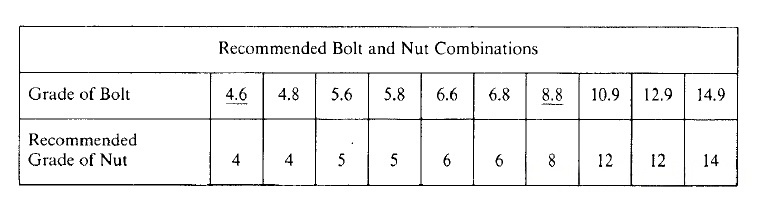
4. European Standard Bolt Length Calculation: Rounding Rules & Additional Length for HSFG Bolts
Calculating the correct bolt length is crucial to avoid installation conflicts and ensure connection strength. European standards have clear requirements for the rounding of ordinary bolts and the additional length of HSFG (High-Strength Friction Grip) bolts. Let’s break this down step by step—this part is a bit technical, but we’ll make it easy to understand.
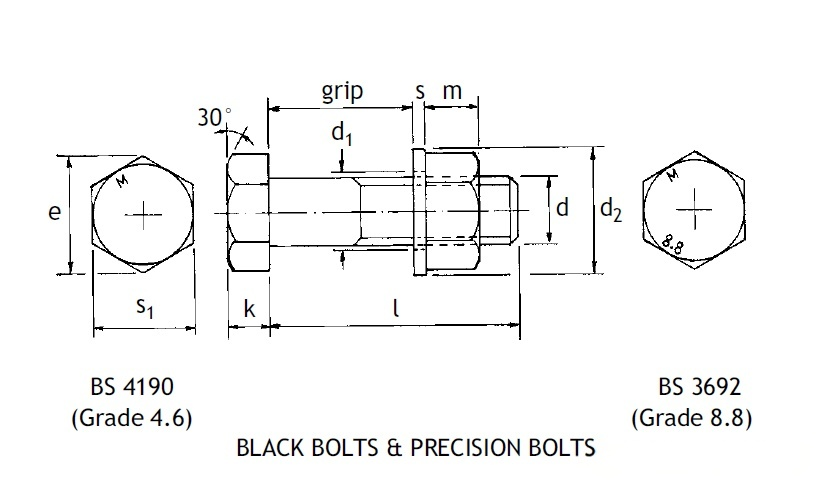
4.1 Rounding Rules
-
Rough ordinary bolts: When the length is ≤80mm, round up in 5mm increments (e.g., 65mm, 70mm, 75mm—non-standard lengths like 63mm or 72mm are not allowed). When the length is >80mm, round up in 10mm increments (e.g., 90mm, 100mm, 110mm).
-
HSFG high-strength friction grip bolts: When the length is ≤100mm, round up in 5mm increments; when the length is >100mm, round up in 10mm increments. The rounding range for HSFG bolts is more flexible because they require higher length accuracy—rounding in 5mm increments for short lengths allows better adaptation to different thicknesses of connecting components.
4.2 Additional Length Calculation for HSFG Bolts (According to British Standard BS 4395)
The total length of an HSFG bolt = total thickness of connecting components + additional length. The “additional length” is the key difficulty here—you need to clearly define the starting point of the calculation and the thickness of the parts included.
4.2.1 Calculation Starting Point
The additional length starts from the “outer surface of the outermost connecting component”—that is, after the bolt passes through all connecting components, the length from the surface of the outermost component to the end of the bolt after the nut is tightened.
4.2.2 Parts Included in Additional Length
-
Nut thickness: According to the standard thickness of European standard nuts (e.g., M20 nut thickness is 16.9mm);
-
Washer thickness (if used): Usually 3-5mm, which should be included according to the actual washer specification selected;
-
Reserved length at the bolt end: To ensure that after the nut is tightened, the bolt end exposes 2-3 threads of the nut. Generally, reserve 6-10mm (adjust according to the bolt diameter—the larger the diameter, the longer the reserve).
Let’s take an example to make this clearer: For an M20 HSFG bolt passing through 3 connecting components with a total thickness of 60mm, matched with an M20×16.9mm nut, plus a 4mm thick washer, and a reserved end length of 8mm. The additional length = 16.9 + 4 + 8 ≈ 29mm, and the total length = 60 + 29 = 89mm. According to the rounding rule (round up in 5mm increments for lengths ≤100mm), the final bolt length is 90mm.
Key reminder: Don’t miss the thickness of any part in the additional length, and the reserved length shouldn’t be too short (less than 2 threads will make it impossible to tighten the nut) or too long (more than 15mm will waste materials and may affect structural space). You must strictly follow the requirements of BS 4395.
Conclusion
The core of selecting and calculating European standard bolts is: “grade matches strength, material adapts to working conditions, matching ensures balance, and length is accurate and compliant”. In engineering practice, you need to combine the type of node force, component material, and installation process, and strictly follow standards such as EN ISO 898 and BS 4395. Avoid mixing grades, mismatching nuts, or randomly determining lengths based on domestic experience.
Especially for HSFG high-strength bolts, the accurate calculation of additional length directly affects the connection quality—you must check the thickness of connecting components, nut and washer specifications, and reserved thread length item by item. Only by fully understanding the technical requirements of European standard bolts can you ensure the safety and reliability of steel structure connections, and avoid project acceptance obstacles or structural hazards caused by bolt problems.
If you’re looking for high-quality European standard bolts (Grade 4.6, 4.8, 8.8, 10.9, 12.9) with S275/S355 materials, feel free to contact us—we provide EU-standard compliant products that meet EN ISO and BS standards, tailored to your project needs.