Alloy Steel vs Carbon Steel: A Practical Material Selection Guide for Engineers
Alloy Steel vs Carbon Steel: A Practical Material Selection Guide for Engineers
When designing mechanical parts, structural components, or industrial machinery, material selection is always one of the most critical decisions engineers have to make. Honestly, most project failures and cost overruns stem from mischoosing between carbon steel and alloy steel. Many engineers simply pick materials based on static strength data or habitual experience, without considering fatigue performance, machinability, weldability, and post-processing costs.
So, what is the real difference between carbon steel and alloy steel? More importantly, how do you select the right one for your specific working conditions? In this comprehensive guide, we will break down their definitions, mechanical properties, processing performance, cost differences, and applicable scenarios, helping you make accurate, cost-effective, and failure-free material choices.
What Is Carbon Steel?
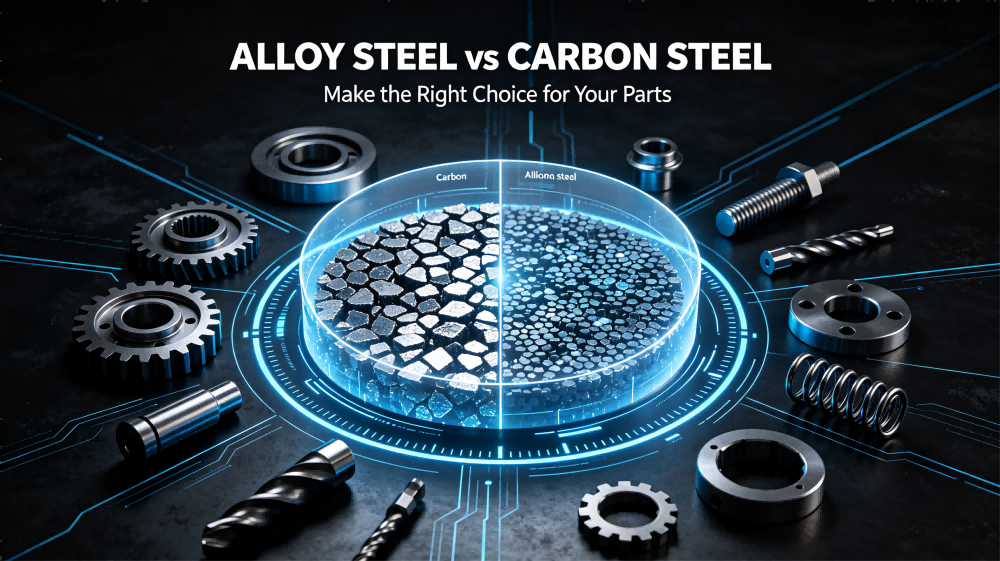
Simply put, carbon steel is a ferrous alloy that takes carbon as its core strengthening element. Typically, its carbon content ranges from 0.05% to 2.0%, with only trace amounts of manganese and silicon included. Unlike high-grade alloy steel, the performance of carbon steel mainly depends on its carbon content and subsequent heat treatment processes. Generally, we divide carbon steel into three core categories, each with unique characteristics and mature application scenarios.
Low Carbon Steel (Carbon Content < 0.25%)
Low carbon steel features excellent ductility, superb plasticity, and outstanding weldability, with extremely low cracking risks during processing. The most widely used domestic grades are 10# and 20# steel, which perfectly correspond to the international AISI 1018 standard. Thanks to its stable and easy-to-process performance, it is extensively applied in welded components, stamping parts, and general structural brackets across various industries.
Medium Carbon Steel (Carbon Content 0.25%~0.6%)
Medium carbon steel strikes an ideal balance between mechanical strength and cutting machinability. Among all grades, 45# steel (equivalent to AISI 1045) is the most mainstream option in domestic mechanical manufacturing. It serves as the most versatile carbon steel for general-purpose pins, ordinary gears, flanges, and conventional mechanical structural parts, covering most standard static-load working scenarios.
High Carbon Steel (Carbon Content > 0.6%)
High carbon steel boasts extremely high surface hardness and wear resistance, while its toughness is relatively lower compared to low and medium carbon steel. Common domestic grades include 65# and 80# steel. In actual production, it is mainly used for manufacturing elastic and wear-resistant parts such as industrial springs, precision cutting tools, and wear-resistant bushings.
What Is Alloy Steel?
Unlike ordinary carbon steel, alloy steel is produced by intentionally adding specific alloying elements like chromium (Cr), molybdenum (Mo), nickel (Ni), and vanadium (V). For low-alloy steel grades, the total alloy content is usually controlled between 1% and 5%, fully complying with the GB/T 3077 standard for alloy structural steel.
In fact, the core advantage of alloy steel lies in its optimized material structure through multi-element alloy matching and professional heat treatment. As a result, it delivers far better fatigue resistance, deeper hardenability, and more stable overall performance under harsh working conditions than conventional carbon steel.
Core Functions of Common Alloying Elements
Each alloying element plays an irreplaceable role in improving steel performance, and understanding their functions is the basis for precise material selection:
-
Chromium (Cr): Effectively improves material hardness and wear resistance; typical mainstream grades include 40Cr and 35CrMo.
-
Molybdenum (Mo): Greatly enhances high-temperature strength and overall hardenability; widely used in 35CrMo and 40CrNiMoA.
-
Nickel (Ni): Significantly boosts material toughness and impact resistance; commonly seen in 40CrNiMoA and 12CrNi3A.
-
Vanadium (V): Refines internal metal grains and improves overall structural strength; represented by 40CrV.
Mechanical Performance Comparison: Strength, Hardness and Fatigue Resistance
There is no denying that heat treatment greatly widens the performance gap between carbon steel and alloy steel. The chromium and molybdenum elements in alloy steel dramatically improve hardenability, enabling uniform mechanical performance distribution in thick-wall sections.
In practical engineering, this difference is extremely obvious. When the part thickness exceeds 20 to 30mm, carbon steel suffers from insufficient hardenability, resulting in a common defect: hard surface but soft core, with extremely uneven hardness distribution. On the contrary, alloy steel can maintain consistent and stable strength throughout the entire cross-section. This is precisely why large-diameter gears and transmission shafts (over 25mm in diameter) always prioritize alloy steel.
Grade Benchmark: AISI 1045 Carbon Steel vs AISI 4140 Alloy Steel
To make the performance difference more intuitive, we take the two most representative grades for detailed comparison:
|
Performance Index
|
AISI 1045 Carbon Steel
|
AISI 4140 Alloy Steel
|
|---|---|---|
|
Yield Strength
|
310~450MPa
|
650~850MPa
|
|
Tensile Strength
|
570~700MPa
|
850~1100MPa
|
|
Strength Improvement After Quenching & Tempering
|
Limited
|
Significant
|
|
Section Size Impact
|
Obvious strength drop for thick parts
|
Uniform and stable strength distribution
|
Hardness Performance in Different Processing States
Generally speaking, carbon steel is more suitable for surface quenching scenarios, while alloy steel is ideal for overall full hardening, which is essential for parts requiring uniform full-section hardness.
|
Material State
|
AISI 1045 Carbon Steel
|
AISI 4140 Alloy Steel
|
|---|---|---|
|
Machining State
|
10~20HRC
|
15~25HRC
|
|
Induction Hardening
|
Surface 50~55HRC
|
Deep layer 55~60HRC
|
|
Overall Quenching & Tempering
|
Shallow hardened layer, 45~50HRC
|
Overall uniform hardness, 50~55HRC
|
Impact Toughness and Fatigue Resistance
Undoubtedly, toughness and fatigue resistance are the most critical performance gaps between the two materials in actual working conditions.
|
Performance
|
Carbon Steel
|
Alloy Steel
|
|---|---|---|
|
Impact Toughness
|
Moderate
|
Excellent (optimized by Cr-Ni alloy)
|
|
Fatigue Resistance
|
Poor
|
Greatly improved
|
|
Crack Propagation Speed
|
Fast
|
Slow
|
|
Cyclic Load Service Life
|
Short
|
Longer
|
In practical applications, 1045 carbon steel performs competently under static load for rotating transmission shafts. However, under high-cycle fatigue conditions of more than 1 million cycles, the service life of 4140 alloy steel is 2 to 5 times that of carbon steel. Regrettably, many engineers fall into a typical misunderstanding: they only refer to static strength data while ignoring fatigue performance, leading to sudden failure of cyclically stressed parts in actual operation.
Machinability & Process Performance Comparison
When it comes to CNC machining, carbon steel has obvious advantages. It features smooth cutting, stable chip breaking, low cutting force, and uniform surface quality. Specifically, 1018 low carbon steel produces short and easy-to-handle chips with high material removal efficiency; normalized 1045 carbon steel can be stably processed with conventional carbide tools.
On the flip side, alloy steel with higher strength brings greater processing challenges. It has large cutting resistance, generates excessive processing heat, and requires equipment with higher rigidity and optimized cutting parameters. For complex parts with tolerance accuracy below ±0.01mm, alloy steel requires longer processing cycles and higher programming technology requirements.
|
Comparison Item
|
Carbon Steel
|
Alloy Steel
|
|---|---|---|
|
Cutting Speed
|
120~180m/min
|
80~140m/min
|
|
Tool Wear Rate
|
Moderate
|
Fast
|
|
Applicable Tools
|
Ordinary Carbide Tools
|
Coated Carbide / Ceramic Tools
|
|
Processing Heat Generation
|
Low
|
High
|
|
Chip Breaking Difficulty
|
Easy, stable short chips
|
Difficult, prone to long chips
|
In actual workshop production, alloy steel tool loss is 20% to 50% higher than carbon steel, especially when the hardness exceeds 30HRC. Measured data shows that the processing time of 4140 steel with 30HRC hardness is about 25% longer than normalized 1045 carbon steel. For mass production of over 1000 pieces, this time difference will significantly increase overall production costs.
Weldability Differences
Welding performance is mainly determined by carbon content and alloy elements, and we usually use the carbon equivalent (CE) formula to evaluate weldability: CE = C + Mn/6 + (Cr+Mo+V)/5 + (Ni+Cu)/15.
Low carbon steel such as 20# steel has a carbon equivalent below 0.40, delivering excellent weldability. It basically requires no preheating and has an extremely low cracking risk, which is very suitable for mass welding production. It can adopt conventional arc welding and MIG welding processes, with a welding qualification rate of over 98%, and is widely used for welding brackets, frames, and flange structural parts.
Nevertheless, alloy steel contains chromium and molybdenum elements with high hardenability, leading to a much higher carbon equivalent (usually 0.45 to 0.55). Its weldability is greatly reduced, requiring strict preheating treatment at 150~300°C and post-weld heat treatment (PWHT) to release residual stress. Meanwhile, the heat-affected zone (HAZ) faces a high risk of hydrogen-induced cracking.
As a general rule, carbon steel is the preferred choice for welded structures, unless extreme strength requirements mandate the use of alloy steel. A common engineering mistake is specifying 4140 alloy steel for welded components without marking PWHT requirements, resulting in delayed cracking of the heat-affected zone weeks after welding.
Heat Treatment & Deformation Risk
|
Comparison Item
|
Carbon Steel
|
Alloy Steel
|
|---|---|---|
|
Hardenability
|
Low to Medium
|
High
|
|
Deformation Risk
|
Medium
|
Medium to High (for complex parts)
|
|
Process Complexity
|
Simple
|
Complex
|
|
Post-Heat-Treatment Grinding
|
Rarely required
|
Essential for precision parts
|
The heat treatment process of 45# carbon steel is simple and accessible for most ordinary heat treatment factories. Although thick sections have uneven hardening, it will not affect conventional working conditions. In contrast, 40CrNiMoA alloy steel can achieve overall full hardening, but precision parts are prone to dimensional deformation after heat treatment, requiring additional grinding correction. This process adds an extra cost of $1.5 to $4.5 per piece for gears and shafts, a detail often overlooked in procurement quotations that leads to final cost overruns.
Practical Engineer Material Selection Guide
Scenarios for Carbon Steel
-
Cost-sensitive and simple processing projects: brackets, frames, base plates, and medium-low load structural parts
-
Mass welded components: low carbon steel ensures joint integrity without preheating
-
High-volume production: effectively saves material and processing costs
-
Short-cycle wearing parts with low replacement costs
Scenarios for Alloy Steel
-
High-performance and high-reliability components: gears, transmission shafts, and heavy-load impact bearing parts
-
Parts requiring long fatigue life (over 10⁵~10⁶ cyclic loads)
-
Thick cross-section parts (over 20~30mm) needing uniform overall strength
-
Wear-resistant contact surfaces and parts working in high-temperature or mild corrosion environments
Core Selection Logic
-
Key load-bearing or fatigue-sensitive parts → Prefer alloy steel
-
Cost priority and simple processing → Prefer carbon steel
-
Thick-section or harsh working conditions → Prefer alloy steel
-
Welded structural parts → Prefer low carbon steel
-
Balanced strength and weldability → Choose 1045 medium carbon steel or alloy steel with PWHT process
Common Material Selection Mistakes & Key Notes
1. Blind Pursuit of Higher Strength
Many engineers hold the wrong view that “higher strength means better performance” and default to alloy steel. In fact, alloy steel processing costs are 20% to 40% higher than carbon steel. For most static and low-load scenarios, carbon steel can fully meet usage requirements, and blindly choosing alloy steel will only cause unnecessary cost waste.
2. Ignoring Fatigue Performance
Focusing only on static strength data while ignoring dynamic and cyclic loads is a fatal flaw in material selection. Carbon steel may pass static strength tests, but it is prone to early fatigue failure under repeated loads. For rotating parts such as shafts and gears, fatigue analysis must be conducted to verify material adaptability.
3. Neglecting Weldability Limitations
It is wrong to assume alloy steel is suitable for all welded structures. Without preheating and PWHT treatment, alloy steel welds are highly prone to cracking and rework. It is necessary to calculate the carbon equivalent in advance to confirm welding feasibility and formulate standardized welding processes.
4. Overlooking Heat Treatment Deformation
Alloy steel will deform after quenching and tempering, which may cause precision parts to exceed tolerance ranges. When selecting alloy steel for high-precision products, the additional cost and dimensional error of post-heat-treatment grinding must be included in the overall budget.
5. Single Material Cost Evaluation
Material unit price only accounts for 25% to 35% of the total part cost. Processing loss, tool consumption, heat treatment, surface treatment, and service life are the core factors affecting comprehensive costs. Saving a small amount of material cost may lead to increased processing costs and shortened product service life.
Final Summary
To sum up, carbon steel features easy processing, excellent weldability, and low comprehensive cost, making it the best choice for conventional static-load mechanical parts and structural components. On the other hand, alloy steel boasts high strength, outstanding fatigue resistance, and superior hardenability, which is irreplaceable for thick-wall parts, high-cycle fatigue components, and equipment working in harsh environments.
The most scientific material selection principle is to choose the lowest-cost steel grade on the premise of meeting product performance and service life requirements, avoiding over-design or insufficient material performance.