Common Surface Treatments of Hot-Dip Galvanized Steel Coils & Their Properties
In modern industrial manufacturing, hot-dip galvanized steel coils have become an indispensable structural material thanks to their excellent corrosion resistance and formability. Different applications, from home appliances and electronics to construction and automotive parts, impose distinct requirements on surface quality and service performance.
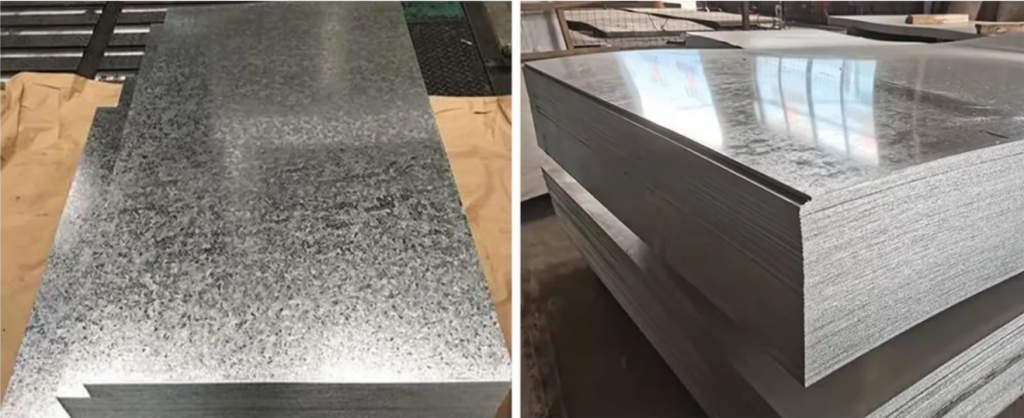
Common Surface Treatment Types & Properties of Hot-Dip Galvanized Steel Coils
1. No Surface Treatment (Bare Surface)
- Characteristics:
Prone to white rust, scratches, and friction marks during handling, storage, and transportation.
- Advantages:
Reduces cleaning and degreasing pressure in downstream processing, lowering energy consumption and carbon emissions.
- Disadvantages:
Extremely high requirements for logistics and storage management; high risk of surface quality disputes.
- Applications:
Used only when immediate in-house processing or post-treatment is planned.
2. Oiled Only
- Characteristics:
Effectively prevents white rust during storage and transportation.
- Advantages:
Cost-effective, highly versatile, and compatible with most general processing.
- Disadvantages:
Lower protection compared to passivated or coated surfaces; the oil is typically not intended as stamping or drawing lubricant.
- Applications:
General fabrication, structural parts, components with follow-up cleaning or painting.
3. Chromate Passivation & Chromium-Free (Organic) Passivation
- Characteristics:
Significantly reduces white rust; provides minor anti-friction and lubrication benefits.
- Advantages:
Strong anti-corrosion performance; chromium-free passivation complies with RoHS directives, eliminating harmful hexavalent chromium.
- Applications:
General industrial parts, electrical enclosures, and export products requiring environmental compliance.
4. Chromate Passivation + Oiling & Chromium-Free Passivation + Oiling
- Characteristics:
Dual protection for long-term corrosion resistance.
- Advantages:
Excellent resistance to humid and marine environments; ideal for long-distance sea transportation.
- Applications:
Overseas export orders, especially for Southeast Asia, Middle East, and other tropical or coastal regions.
5. Chromium-Free Anti-Fingerprint (AFP)
- Characteristics:
Prevents white rust; resists stains and sweat marks from manual handling.
- Advantages:
Environmentally friendly (chromium-free, RoHS compliant); improves surface appearance; provides moderate stamping lubricity.
- Applications:
Home appliances, refrigerators, washing machines, air conditioners, and visible metal components.
6. Self-Lubricating Coating
- Characteristics:
Protects against white rust while greatly improving formability.
- Advantages:
Reduces die wear and scratching during stamping, bending, and deep drawing.
- Applications:
Complex stamped parts, automotive components, and precision metal forming.
7. Inorganic Solid Lubrication
- Characteristics:
Forms a hard inorganic film with exceptional lubricity.
- Advantages:
Excellent surface hardness, superior deep-drawing performance, and stable coating adhesion.
- Disadvantages:
Relatively weaker standalone corrosion resistance.
- Applications:
High-strength forming parts, components requiring painting or bonding.
8. Chromium-Free High-Conductivity Anti-Fingerprint
- Characteristics:
Chromium-free, anti-fingerprint, and highly conductive.
- Advantages:
Improves electrical grounding performance and enhances EMC (Electromagnetic Compatibility).
- Applications:
Office automation equipment, copiers, printers, computers, and electronic enclosures.